
A Thanksgiving dinner can provide enough food for several days of meals, but the useful life of those leftovers depends on more than finding room in the refrigerator. Turkey, stuffing, gravy, casseroles, cranberry sauce, and desserts have different storage characteristics, and the way each dish is handled after cooking influences both its safety and its quality. Even food that was prepared and cooked correctly can become unsafe if it cools too slowly or remains at room temperature for an extended period.
Most cooked Thanksgiving leftovers can be refrigerated for three to four days when properly handled and stored at 40°F (4°C) or below. Freezing extends their storage life considerably, although some dishes retain their original flavor and texture better than others. Knowing which foods to eat first, which to freeze, and how to package them can preserve much of the work that went into preparing the holiday meal.
Understanding the Three-to-Four-Day Rule
The United States Department of Agriculture recommends consuming or freezing most cooked leftovers within three to four days of preparation. For a traditional Thursday Thanksgiving dinner, the following Monday represents the final recommended day for consuming or freezing most leftovers, provided they were refrigerated promptly and maintained at a safe temperature. Dishes prepared before Thanksgiving may have an earlier storage deadline.
The federal food safety recommendations for Thanksgiving leftovers identify two to six months as a general freezer storage period for maintaining quality, although individual foods have more specific recommendations. Food that was safe when frozen and remains continuously stored at 0°F (-18°C) or below can remain safe indefinitely. Its flavor, appearance, moisture content, and texture may gradually deteriorate during extended storage.
Refrigeration slows microbial growth without stopping it completely. Certain bacteria, including Listeria monocytogenes, can grow at refrigerator temperatures, which is one reason properly refrigerated food still has a limited storage life. Freezing prevents microbial growth under normal frozen storage conditions, but microorganisms that survive freezing can become active again as the food thaws.
Transferring leftovers into a fresh container, incorporating them into another dish, or reheating them should never be treated as a way to rescue food that has already exceeded its safe storage period. Keeping track of the original preparation date provides a reliable basis for managing refrigerated ingredients throughout the holiday weekend.
Thanksgiving Leftover Storage Chart
The following chart draws on the FoodSafety.gov cold food storage guidelines and University of Nebraska-Lincoln Extension holiday food safety recommendations. Refrigerator storage periods assume prompt cooling and continuous storage at 40°F or below. Freezer recommendations apply to eating quality rather than safety expiration dates.
| Thanksgiving Leftover | Refrigerator | Freezer (Best Quality) |
| Roasted turkey | 3 to 4 days | 2 to 6 months |
| Cooked fresh, uncured ham | 3 to 4 days | 3 to 4 months |
| Cooked, commercially prepared spiral-cut ham | 3 to 5 days | 1 to 2 months |
| Cooked stuffing or dressing | 3 to 4 days | 1 month |
| Mashed potatoes | 3 to 4 days | Varies by preparation |
| Cooked sweet potatoes | 3 to 4 days | Varies by preparation |
| Turkey gravy | 3 to 4 days | 2 to 3 months |
| Green bean casserole | 3 to 4 days | 2 to 3 months |
| Cooked vegetable sides | 3 to 4 days | Varies by preparation |
| Turkey soup or stew | 3 to 4 days | 2 to 3 months |
| Turkey or chicken broth | 3 to 4 days | 2 to 3 months |
| Mayonnaise-based turkey salad | 3 to 4 days | Does not freeze well |
| Pumpkin pie | 3 to 4 days | 1 to 2 months |
| Pecan pie | 3 to 4 days | 1 to 2 months |
| Custard or chiffon pie | 3 to 4 days | Freezing not recommended |
Some university extension programs recommend shorter refrigerated storage periods for particular holiday foods. For example, Illinois Extension advises consuming stuffing and giblet gravy within two days, while federal and Nebraska Extension guidance allows three to four days for properly handled preparations. Using or freezing these dishes earlier provides a conservative approach, particularly in a busy household where food may be repeatedly removed from the refrigerator.
Freezer recommendations for prepared vegetable dishes are less straightforward because their composition varies considerably. A plain vegetable preparation behaves differently during freezing than one containing cream, cheese, starch-based sauces, or crisp toppings. Where a specific storage period cannot be reliably applied across different recipes, the chart identifies that variation rather than assigning an unsupported duration.
How Long Can Thanksgiving Dinner Sit Out?
Perishable Thanksgiving dishes should be refrigerated within two hours of cooking or removal from equipment maintaining a safe holding temperature. If the surrounding temperature exceeds 90°F (32°C), the recommended period is reduced to one hour. These limits apply to foods such as cooked poultry, stuffing, gravy, casseroles, and desserts requiring refrigeration.
Food can remain available for serving when maintained at appropriate temperatures. Hot dishes should be held at 140°F (60°C) or above, while refrigerated dishes should remain at 40°F or below. Warming trays, properly functioning chafing dishes, and containers placed over ice can help maintain these conditions during extended gatherings.
The repeated serving of Thanksgiving dinner throughout the afternoon can make storage decisions particularly difficult. Rather than leaving the entire turkey, casserole, or bowl of potato salad available for several hours, reserve smaller quantities for serving and refrigerate the remainder promptly. Replenishing those portions as needed reduces the amount of food exposed to room temperature.
Perishable food that has exceeded the recommended holding period should be discarded. As explained in the FDA’s refrigeration and food safety guidance, certain microorganisms can produce toxins that withstand temperatures sufficient to kill the bacteria themselves. Subsequent refrigeration, freezing, or reheating cannot reliably restore the safety of improperly handled food.
Cooling and Packaging Thanksgiving Leftovers
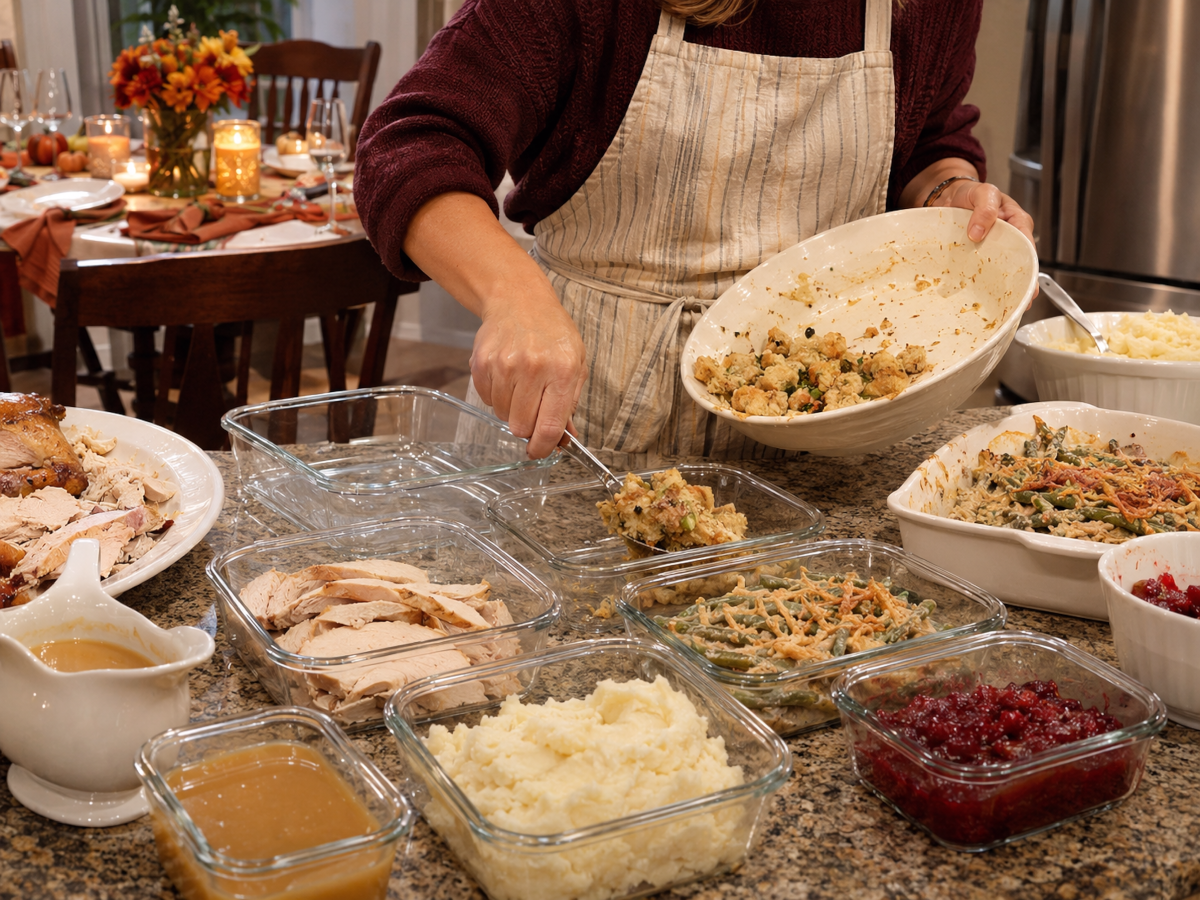
Hot leftovers do not need to reach room temperature before entering the refrigerator. Dividing food into smaller quantities allows it to cool more efficiently and avoids the extended countertop cooling that can encourage bacterial growth. A large pot of soup, a deep casserole, or an entire roasted turkey should be divided into manageable portions before refrigeration.
Shallow containers expose a greater proportion of the food to the surrounding cooler environment and reduce the distance heat must travel from the center of the food. Large quantities of soup, broth, or gravy can also be cooled rapidly using an ice-water bath, stirring periodically to distribute the cooling throughout the liquid. These methods help reduce the amount of time dense preparations remain warm.
Refrigerator organization becomes particularly relevant after a large holiday meal. Packing shelves tightly with numerous containers can restrict cold air circulation, so leave space around newly stored food where practical. An inexpensive appliance thermometer provides a more dependable indication of storage conditions than the numbered settings on a refrigerator’s temperature control.
Label containers with the name of the dish and its original preparation date. Freezer packages should also identify when the food was frozen, particularly if several batches of cooked meat, stock, gravy, and prepared meals accumulate throughout the holiday season. Clear labeling makes it easier to use older portions before their quality declines.
Storing Leftover Thanksgiving Turkey and Ham
Remove any remaining stuffing from the turkey cavity and refrigerate it separately. Carve the remaining meat from the carcass and divide it among shallow, covered containers rather than attempting to refrigerate a large, partially carved bird. Smaller portions lose heat more efficiently and are easier to retrieve for subsequent meals.
Separating white and dark meat can also be useful from a culinary standpoint. Breast meat is generally leaner and more susceptible to drying during reheating, while thigh and drumstick meat tends to tolerate additional cooking better. Breast meat works well in sandwiches and salads, while dark meat is particularly useful in soups, casseroles, and pot pie fillings.
Turkey intended for freezing can be portioned according to how it will eventually be used. Sliced meat is convenient for individual meals, while diced or shredded turkey can be packaged for soups and fillings. Adding a little broth before freezing can help protect the meat from drying, although storing it plain provides more flexibility when preparing dishes with different seasonings.
The turkey carcass can also be refrigerated promptly or frozen for making stock. Breaking it into smaller sections makes storage easier and helps any remaining meat and connective tissue cool more efficiently. Bones and connective tissues can contribute flavor and gelatin to stock even after most of the usable meat has been removed.
Ham requires additional consideration because curing, processing, packaging, and preparation influence its recommended storage life. Commercially prepared spiral-cut ham has different storage guidelines from fresh, uncured pork that has been roasted at home. Follow the recommendations for the specific type of ham, along with any more restrictive storage directions supplied by the manufacturer.
Stuffing, Dressing, and Thanksgiving Gravy
Cooked stuffing contains bread, moisture, vegetables, seasonings, and sometimes eggs, sausage, or poultry drippings. Its moist interior makes it a perishable preparation regardless of whether it was cooked inside the turkey or baked separately. Stuffing should be removed from the serving dish or turkey cavity and divided into smaller containers for prompt cooling.
Freezing stuffing early in the holiday weekend is a practical option when substantial quantities remain. Its recommended freezer quality period is approximately one month, making it a useful ingredient for another holiday meal in December. Reheating it in a covered baking dish helps limit moisture loss, while uncovering it toward the end of heating allows the exposed surface to regain some crispness.
Gravy frequently thickens during refrigeration as gelatin sets and cooked starches undergo structural changes. These changes are normal and do not, by themselves, indicate spoilage. The consistency often loosens as the gravy warms, although some preparations may require a small addition of broth.
Freezing can cause starch-thickened or dairy-containing gravies to release liquid or separate after thawing. Whisking during reheating may help restore a smoother consistency, while additional broth can correct excessive thickness. Bring leftover gravy to a rolling boil during reheating, stirring frequently to distribute heat and prevent scorching.
Mashed Potatoes, Sweet Potatoes, and Vegetable Casseroles
Mashed potatoes generally follow the standard three-to-four-day refrigerated storage recommendation. Their dense consistency makes shallow containers particularly useful when a substantial quantity remains after dinner. Dividing them into meal-sized portions also avoids repeatedly warming and cooling a large batch.
Freezing cooked potatoes can produce changes in both their water distribution and starch structure. Thawed potatoes may become grainy, watery, or less cohesive than freshly prepared mash, and the extent of these changes depends partly on the recipe. Gentle reheating with a little butter, milk, or cream may improve their consistency, although it cannot necessarily restore the original texture.
Mashed sweet potatoes can also be frozen, but their toppings deserve separate consideration. Marshmallows, candied nuts, and streusel can absorb moisture or lose their original texture during storage. When planning to freeze a portion, removing these toppings where practical and adding fresh ones during reheating may produce a better result.
Green bean casserole presents several of the difficulties associated with freezing prepared dishes. The beans may soften, milk-based sauces can separate, and crisp onion toppings generally absorb moisture during storage. The National Center for Home Food Preservation’s guidance on foods that freeze poorly identifies milk sauces, certain cooked potatoes, and casserole toppings among preparations susceptible to quality deterioration.
These changes do not make properly frozen casseroles unsuitable for eating, but they may influence which dishes are worth freezing. A casserole that has lost some of its surface crispness can often be refreshed with newly prepared toppings after reheating. Roasted vegetables may also benefit from oven reheating, which encourages surface moisture to evaporate more effectively than covered microwave heating.
Cranberry Sauce and Refrigerated Desserts
Cranberries are naturally acidic, and traditional cranberry preparations often contain considerable quantities of sugar. Acidity and sugar concentration can influence microbial growth, although the preservative effect depends on the formulation of the finished product. Homemade cranberry sauce should therefore never be assumed to be shelf-stable simply because it contains fruit and sugar.
The University of Illinois Extension’s holiday leftover storage recommendations allow up to two weeks for refrigerated canned cranberry sauce and seven days for homemade cranberry relish. These recommendations apply to the specified products and should not automatically be extended to every homemade cranberry preparation. For homemade sauces without a reliable recipe-specific storage recommendation, using or freezing them within the general leftover storage period is a conservative approach.
Cranberry sauce can be frozen in small portions for later meals. It remains useful well beyond Thanksgiving as an accompaniment to roasted pork, an ingredient in fruit-based glazes, or a spread for sandwiches. Freezing individual portions makes it possible to use these quantities without thawing an entire container.
Homemade pumpkin pie contains eggs and generally milk or cream, making its filling a perishable custard. Homemade pecan pie also contains eggs and requires refrigeration after baking and appropriate cooling. Both pies should generally be consumed within three to four days or frozen for longer storage, with one to two months recommended for freezer quality.
Other desserts require storage decisions based on their ingredients. Cream pies, cheesecakes, and desserts containing whipped cream require refrigeration, while traditional fruit pies without perishable fillings may have different storage requirements. Commercially prepared pies may also be formulated for different conditions, so their packaging instructions should be followed.
Cream and chiffon pies generally perform poorly during freezing because their fillings can separate, release moisture, or lose their structure during thawing. Pumpkin and pecan pies are better candidates for freezing under the published storage guidelines. Packaging individual slices separately can be particularly convenient when only one or two portions are needed at a time.
Why Some Thanksgiving Leftovers Freeze Better Than Others
Water expands and forms ice crystals during freezing, altering the physical structure of many foods. In vegetables, these crystals can damage cellular structures, contributing to softer textures and increased moisture release during thawing. The effect is often less noticeable in foods that have already been thoroughly cooked and softened.
The University of Minnesota Extension’s food freezing guidance explains how smaller packages, rapid freezing, and appropriate packaging help preserve quality. Dividing chilled leftovers into smaller portions allows them to freeze more quickly and reduces the need to thaw food that will not be consumed immediately.
Freezer burn develops when moisture is lost from the surface of frozen food. On cooked turkey, it may appear as dry, discolored patches that become tough or unpleasant after reheating. Although freezer burn itself does not make properly stored food unsafe, it can substantially reduce eating quality.
Freezer-safe bags and tightly sealed containers limit air exposure and surface moisture loss. Remove excess air from bags containing solid foods, and leave sufficient expansion space in containers holding broth, gravy, or soup. Avoid crowding the freezer with large quantities of unfrozen food at once, since this can slow the freezing process.
Thawing and Reheating Thanksgiving Leftovers Safely
Refrigerator thawing is generally the most convenient method when meals can be planned in advance. Moving frozen portions into the refrigerator the evening before they are needed allows them to thaw under controlled temperature conditions, although larger or denser packages may require additional time.
Cold-water thawing is another option, provided the food is enclosed in leakproof packaging and the cold water is replaced every 30 minutes. Leftovers thawed using this method should be reheated promptly. Microwave thawing should proceed directly into reheating, bringing the food to a safe internal temperature of 165°F (74°C).
Many frozen soups, stews, and casseroles can also be reheated directly from their frozen state. Allow additional heating time and use a food thermometer to check the center and other potentially cooler areas. Dense casseroles can become hot around their edges while remaining insufficiently heated in the middle.
Cooked leftovers being reheated should reach 165°F throughout, and soups, sauces, and gravies should be brought to a rolling boil. When using a microwave, cover the food appropriately, stir or rotate it where possible, allow an appropriate standing period, and check the temperature in several locations. Avoid reheating cold leftovers in a slow cooker, where the food may remain at unsafe intermediate temperatures for too long.
Reheating only the quantity needed for a particular meal also helps preserve culinary quality. Repeated heating can dry out turkey, soften vegetable dishes, and thicken sauces through moisture loss. A small addition of broth to sliced turkey or milk to mashed potatoes can help compensate for some of these changes.
Recognizing When Thanksgiving Leftovers Should Be Discarded
Visible mold, unexpected odors, slimy surfaces, and other obvious signs of spoilage provide sufficient reason to discard a prepared dish. Changes such as freezer burn, hardened gravy, or softened vegetables after thawing are different because they can occur through ordinary physical changes without indicating microbial contamination.
Unfortunately, harmful bacteria may be present without producing noticeable changes in appearance, odor, or flavor. Tasting questionable leftovers cannot establish their safety, and reheating them does not necessarily eliminate every hazard associated with improper storage.
The most reliable basis for deciding whether leftovers remain suitable for consumption is their documented storage history. Perishable food that has exceeded its recommended refrigerated storage period, remained at room temperature too long, or experienced unsafe temperatures should be discarded even if it still looks and smells appetizing.
Planning Thanksgiving Leftovers Beyond the Holiday Weekend
Deciding how to use Thanksgiving leftovers becomes easier when those decisions are made during the initial cleanup. Refrigerate a realistic quantity of food for the next several days and freeze portions intended for later meals. There is little culinary advantage in waiting until Monday to freeze food that could have been packaged on Thursday or Friday.
Consider how ingredients might be combined in future meals before deciding how to portion them. Turkey and gravy can be reserved for pot pie, shredded meat can be packaged for soup, and mashed potatoes can become the topping for a turkey or vegetable casserole. Keeping these components separate provides greater flexibility when adjusting seasonings, adding fresh ingredients, or preparing meals of different sizes.
Homemade stock offers another opportunity to extend the usefulness of the holiday meal. A turkey carcass can provide the foundation for soups, risotto, sauces, and braised dishes throughout the following months. Freezing the finished stock in several container sizes allows a small quantity to be used for a pan sauce or a larger portion to become the base of an entire meal, making practical use of ingredients that might otherwise have been discarded.